
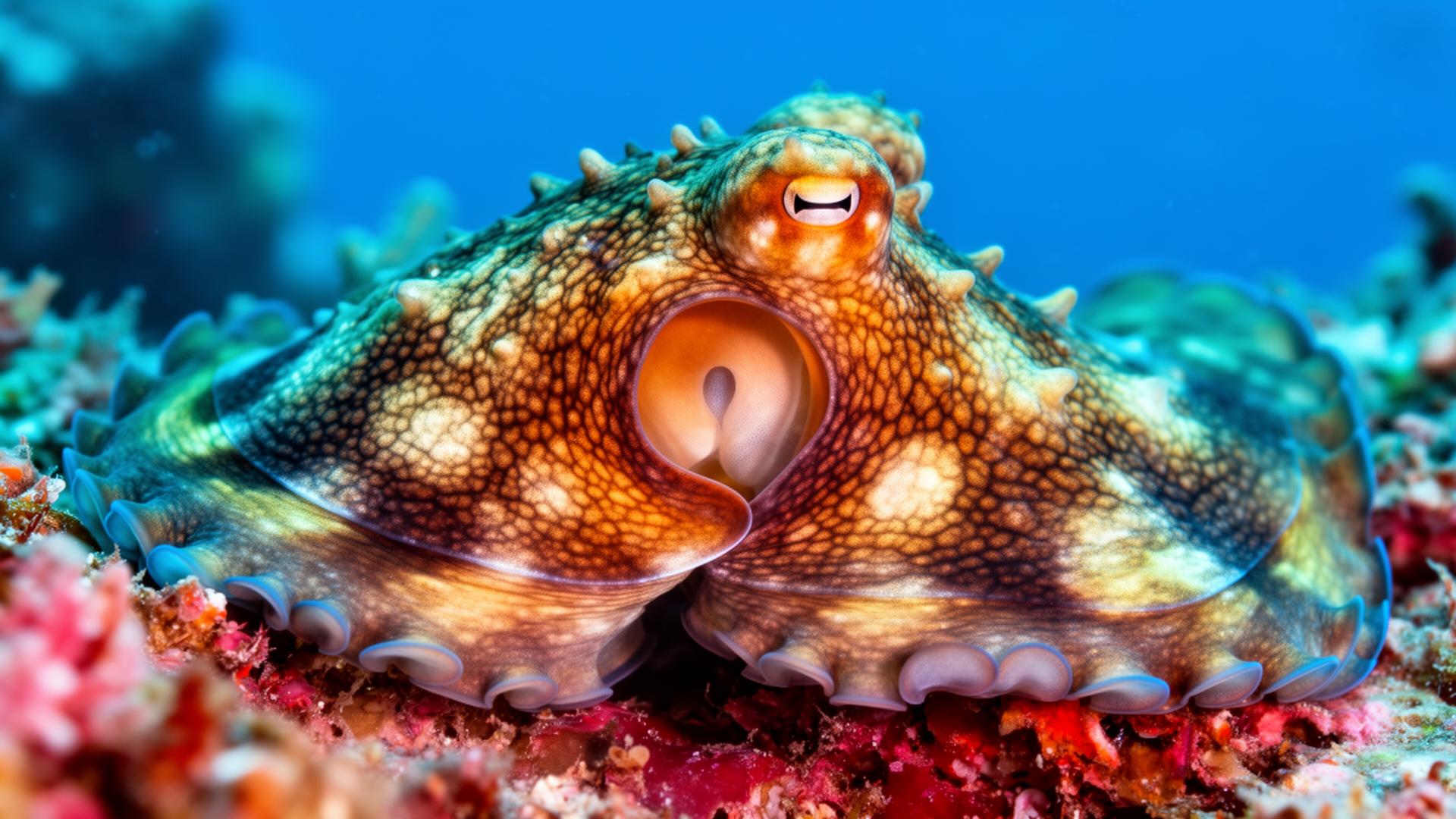
Meet the octopus.
Three hearts, blue blood, eight arms covered in tasting suckers, and a brain to coordinate it all. The octopus (heʻe) is one of the strangest, smartest animals in the Pacific.
The reef's cleverest shapeshifter.
The octopus is a cephalopod mollusc, most closely related to squid, cuttlefish, and the chambered nautilus. They completely lack the shell of more distant mollusc relatives like snails and bivalves, but share the same basic body design: a head with eyes, a muscular foot modified into eight arms, and a sac-like body mass enclosing the internal organs and gill chamber.
Octopuses are probably the most intelligent of invertebrates and can learn from experience. Their brain, enclosed in a protective cartilage 'cranium,' interprets sensory input from large, well-developed eyes and the millions of sensory receptors covering their arms. Each arm can taste, touch, and grip independently while the central brain coordinates the whole animal.
Their most famous trick is camouflage. Millions of pigment cells called chromatophores expand or contract on command, changing color and pattern in an instant. Tiny muscles in the skin also contract or relax to change texture, letting an octopus disappear against coral, rubble, or bare sand. The same chromatophores are used to communicate with other octopuses.
Octopuses crawl swiftly across the bottom on eight arms, then dart by jet propulsion when startled, blasting water out through a flexible siphon. Crustacean and mollusc prey is captured with a pounce, paralyzed by venom from the salivary glands, and softened by digestive enzymes before being torn apart by a sharp, parrot-like beak.
In Hawaiʻi there are two common species, often called 'squid' locally. The day octopus (heʻe) is mottled brown and tan, active in daylight, and rests in a den at night. The night octopus (heʻe-mākoko) is rusty red with white spots and hunts after dark. Both have long been important food and cultural species, traditionally caught with cowry-shell lures lashed to a hook.
A new critter every month.
Each month our marine biologists spotlight a different resident. Come back to discover sea jellies, monk seals, giant clams and many more.