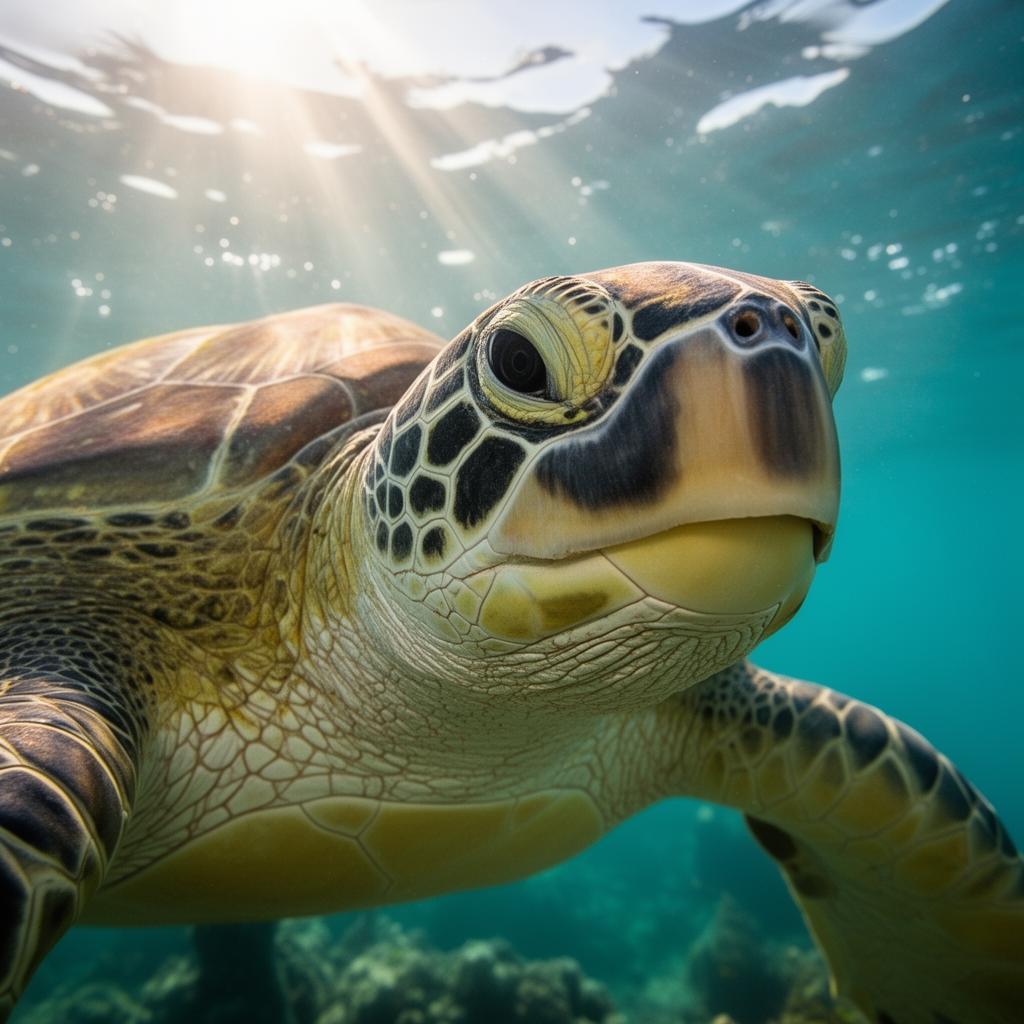
Green Sea Turtle.
Air-breathing ancient mariners. Hawaiian honu can live 80+ years and migrate hundreds of miles between feeding and nesting grounds.
Sea turtles are air-breathing reptiles beautifully adapted for life in the sea. Their body is streamlined to move easily through the water; front flippers are used for swimming, the back flippers act like rudders for steering. Like other reptiles, the sea turtle's skin is protected by tough scales, and like other turtles, fused bony plates form a protective shell (the carapace on top, plastron on the bottom).
Green sea turtles, once widespread throughout the Hawaiian Islands, are now recognized as a threatened species. Habitat destruction, human disturbance, and overharvesting led to a dramatic decline. Since protection, the number of nesting females has increased about 5.7% per year at French Frigate Shoals, where 90% of Hawaiian nesting occurs.
After mating at sea, female green turtles crawl ashore at night, dig a hole in the sandy beach, and lay about 100 leathery eggs. Each female may lay up to six clutches each breeding season. Young turtles hatch as a group after about two months and rush to the sea.
Hawaiian honu grow very slowly and may be 20 to 35 years old before they are sexually mature. Adults can reach shell lengths of 4 feet (1.2 m) and weigh up to 400 pounds. Hawaiian green sea turtles are unique in spending their entire lives within the Hawaiian Island chain.
In Hawaiʻi, both females and males may crawl ashore to bask in the sun, a behavior found almost nowhere else in the world. This may help them warm up their bodies and protect them from their main predator, the tiger shark.