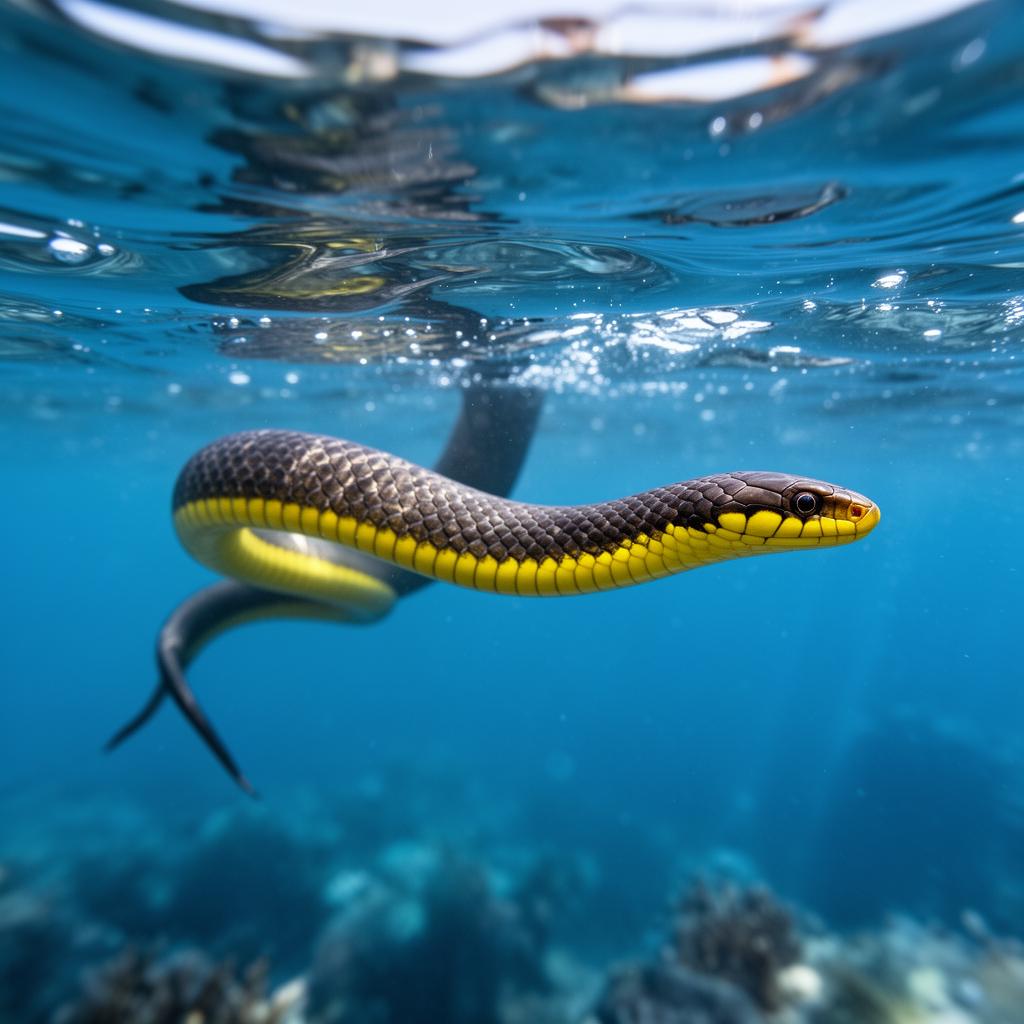
Yellow-Bellied Sea Snake.
The most widespread snake on Earth. A fully marine reptile that drifts on ocean currents and gives birth at sea.
The yellow-bellied sea snake is the most widespread snake species on Earth, found throughout the Indian and Pacific Oceans and from the eastern coast of Africa to the western coast of Central America. Unique among sea snakes, it usually lives completely out at sea, criss-crossing the ocean by riding the currents.
The sea snake's body shows many adaptations for life in the ocean. Valved nostrils are located high on the snout for breathing while swimming or basking at the surface. The belly is tapered like the keel of a boat for stability. The tail is flattened and broadened to form an effective paddle for swimming. These snakes may spend up to 90% of their time underwater and can stay submerged for 10 to 90 minutes.
The large amount of skin between the scales is richly supplied with blood vessels and acts like a gill: oxygen enters and waste carbon dioxide leaves across the skin surface. Excess salt from the seawater and fish diet is excreted through special glands in the snake's mouth.
Yellow-bellied sea snakes are venomous and should never be handled. Bites are extremely rare, but anyone bitten should seek immediate medical care. In Hawaiian waters, sightings are uncommon and the species is not on exhibit at the Aquarium.